Planning a trip to Paris, Rome, or Barcelona? A Schengen visa is the single short-stay visa that opens the door to 29 European countries on one trip. This guide explains how the Schengen visa works, who needs one, which documents to prepare, and how to apply — without the mistakes that get applications refused.
One honest promise before we start: no guide and no agent can guarantee you a visa — the consulate always decides. A complete, honest, well-prepared application gives you the strongest possible chance.
What Is a Schengen Visa?
The Schengen area is a group of 29 European countries that have removed passport checks at their shared borders. Enter one member country, and you can normally travel to the others with no border stops.
The members are 25 EU countries plus Iceland, Liechtenstein, Norway, and Switzerland. Bulgaria and Romania became full members on 1 January 2025, bringing the total to 29.
This is a short-stay (Type C) visa for tourism, business trips, or visiting family and friends. It allows a stay of up to 90 days across the whole area — you do not need a separate visa for each country.
Two EU countries sit outside the area: Ireland runs its own visa system, and Cyprus has not joined yet. The UK is outside too — its separate rules are covered in the “Where to Apply” section below.
This visa is not a work permit. To live, work, or study long-term in Europe, you need a national long-stay visa or residence permit from that specific country.

The 90/180-Day Rule Explained
Every short-stay visa for this area follows the 90/180-day rule: you may stay for a maximum of 90 days within any 180-day period. The 180 days are a rolling window, not a fixed calendar block.
In practice it works like this: on any day of your trip, look back 180 days and count your days inside the area. If the total is 90 or less, you are within the rules. Your entry day and exit day both count.
Crossing from France into Italy does not restart the count — the limit covers all 29 countries combined. Overstaying, even by a few days, can bring a fine, deportation, and problems with future applications.
The European Commission offers a free short-stay calculator on its official website. Enter your entry and exit dates, and it shows how many days you have used and how many remain.
Who Needs a Schengen Visa?
It depends on your passport. Citizens of countries on the EU’s visa-required list must apply for a Schengen visa before they travel. Citizens of visa-exempt countries — such as the United States, the United Kingdom, Canada, and Japan — can visit visa-free for short trips.
The official list changes from time to time, so check your nationality on the European Commission’s website before booking. Some travelers also need a separate airport transit visa just to change planes at a Schengen airport.
Your passport must be valid for at least three months beyond the day you leave the area, whoever you are. And a visa never guarantees entry: border officers can still ask to see your return ticket, bookings, and proof of money.
Where to Apply: Main Destination or First Entry
You cannot choose your consulate freely. EU rules say your application goes to one specific country, decided by your travel plan:
- Main destination rule: apply to the country where you will spend the most nights.
- First entry rule: if you spend equal nights in two or more countries, apply to the country you enter first.
- One country only: if you are visiting just one country, apply to that country.
You apply from the country where you legally live.
Watch out for a common confusion: the United Kingdom is not part of the Schengen area and never has been. This visa does not cover London. If your trip includes the UK, you need a separate UK visitor visa as well.
Applying to the “easiest” country instead of your real main destination is a mistake. Consulates compare your application with your bookings and itinerary, and a mismatch is a known refusal reason.
Schengen Visa Requirements: Document Checklist
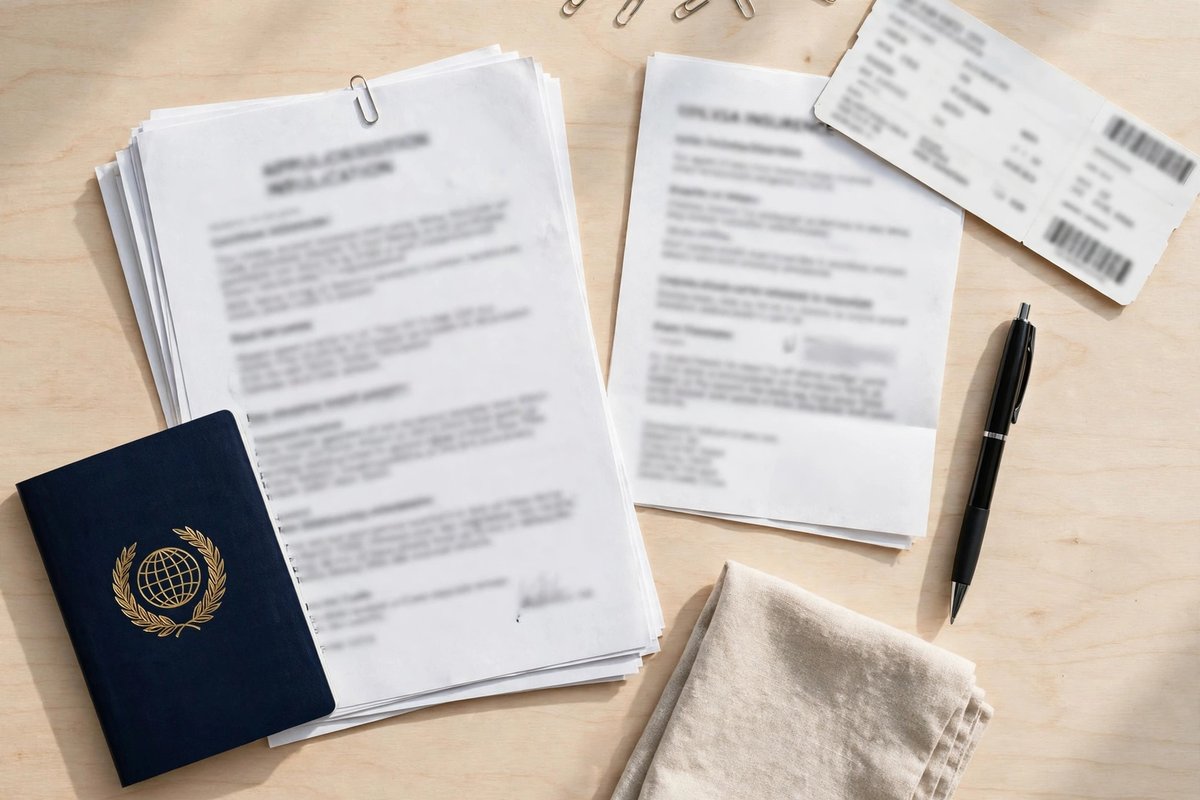
Every member country uses the same core checklist, with small local differences. Always confirm the exact list on the consulate or visa centre website for your destination. The standard documents are:
- Application form — completed in full and signed. Many countries let you fill it in online first.
- Passport — issued within the last 10 years, valid 3+ months after you leave the Schengen area, with at least 2 blank pages.
- Photo — one recent passport-style photo that meets ICAO standards: plain light background, full face clearly visible.
- Travel medical insurance — compulsory, and where many files fail. It must cover at least €30,000 of emergency medical costs and repatriation, be valid in all Schengen countries, and cover your whole stay. A policy missing any of these three points will be rejected.
- Flight reservation — your travel plan into and out of the area. A reservation is normally enough — you do not need to buy a full non-refundable ticket before the decision.
- Proof of accommodation — hotel bookings for every night, or a formal invitation letter if staying with family or friends.
- Proof of money — bank statements from the last 3 to 6 months showing you can pay for the trip, plus payslips or other income proof.
- Proof of ties to home — an employer letter confirming your job and approved leave, a business registration, property documents, or family evidence showing you plan to return home.
- Cover letter and itinerary — a short letter explaining the purpose of the trip, supported by a simple day-by-day plan.
For children, consulates also ask for a birth certificate and written consent from both parents. Students and sponsored travelers need extra documents for their situation. A clear, consistent file is always stronger than a thin one.
How to Apply for a Schengen Visa: Step by Step
Step 1: Fix your travel plan first
Decide your dates, route, and where you will spend the most nights. This decides which country you apply to, and every document afterwards must match this plan.
Step 2: Read the official checklist for that country
Visit the website of that country’s consulate or its official visa application centre in your country of residence, and download the current tourist visa checklist. Requirements change, so never rely on an old post or a friend’s memory.
Step 3: Fill in the application form
Complete the harmonised application form carefully. Names, passport numbers, and dates must match your other documents exactly. Many countries use their own online portal for this.
Step 4: Book your appointment
Most Schengen countries collect applications through an official visa application centre — commonly VFS Global, TLScontact, or BLS International — while some take applications directly at the consulate. Book only through the centre’s official website — in busy seasons, slots fill weeks ahead.
Timing matters too: you may apply up to 6 months before your trip, and no later than 15 days before you travel. Four to 8 weeks ahead is a comfortable target.
Step 5: Attend the appointment and give biometrics
Go in person with your complete file and passport. Staff check your documents, take your fingerprints and photo (your biometrics), and collect the fee. Fingerprints are stored in the EU’s Visa Information System and normally stay valid for 59 months, so frequent travelers may not need to give them again for a while. Children under 12 do not give fingerprints.
Step 6: Pay the fee and wait for the decision
Pay the visa fee — amounts are in the next section — plus the centre’s service charge if you used one. Keep your receipt and tracking number safe. Standard processing is around 15 calendar days, extendable to 45 days if the consulate needs extra checks or an interview.
Related Posts


All of these rules come from the European Commission’s Migration and Home Affairs website — the EU’s official source for visa policy. Bookmark its page Applying for a Schengen visa before you start.

Schengen Visa Fees and Processing Time
The fee is set by EU law and is the same at every Schengen consulate. It was last changed on 11 June 2024; the amounts below are current:
| Item | Details |
|---|---|
| Countries covered | 29 Schengen countries |
| Maximum stay | 90 days in any 180-day period |
| Visa fee — adults and children aged 12+ | €90 |
| Visa fee — children aged 6 to 11 | €45 |
| Visa fee — children under 6 | Free |
| Travel insurance | Minimum €30,000 cover, all Schengen countries, whole stay |
| Earliest you can apply | 6 months before travel |
| Latest you can apply | 15 days before travel |
| Standard processing time | About 15 calendar days (up to 45 in individual cases) |
Three fee facts surprise many first-time applicants. The fee is not refunded if your application is refused. A visa centre’s service charge is extra, set by the centre itself. And a small number of applicants — certain students on study trips and EU citizens’ family members using free-movement rights — are exempt under EU rules.
Single-Entry vs Multiple-Entry Visas
Your visa sticker shows how many times you may enter the area:
- Single-entry: you may enter once. The moment you leave the Schengen area, the visa is used up — even if you stayed only two days.
- Double-entry: you may enter twice during the visa’s validity.
- Multiple-entry (marked “MULT”): you may enter and leave freely while the visa is valid, as long as every stay respects the 90/180-day rule.
A separate airport transit visa exists only for changing planes in a Schengen airport — it never lets you enter the country.
So how do you get a multiple-entry visa? The consulate decides, based on your travel history and documents. Under the EU Visa Code, regular travelers who used previous visas correctly can receive multiple-entry visas valid for one, two, or even five years. First-time applicants usually get one matched to their trip dates — using it correctly is how longer ones are earned.
Remember: validity and stay length are different things. Even a five-year multiple-entry visa limits every stay to 90 days in any 180-day period.
After You Apply: Decision, Collection and Refusals
When a decision is ready, the centre will notify you to collect your passport, or return it by courier if you chose that service. You can usually track your file online with the reference number on your receipt.
If the visa is granted, check the sticker the same day: your name, validity dates, number of entries, and the “duration of stay” figure. If anything looks wrong, contact the consulate immediately — mistakes are far easier to fix before you travel.
If your application is refused, you will receive a standard form ticking the reason or reasons. This is not always the end of the story. You have the right to appeal under that country’s rules, or you can fix the problem and apply again with a stronger file. Read the form carefully — it tells you exactly what the officer doubted.
Preparing a fresh application, or planning a trip under different rules? Browse our other Visa guides for step-by-step country guides.
Common Scams and Red Flags
Popular visa routes attract dishonest sellers. Protect yourself with these rules:
- “Guaranteed visa” sellers. No agent or so-called insider can guarantee a decision or influence a consulate. Anyone selling a guarantee is selling a lie.
- Fake hotel and flight bookings. Some agents sell dummy bookings that are cancelled the moment you pay them. If the consulate finds a cancelled booking, expect refusal and damaged credibility for years. Book real, verifiable reservations instead — many hotels offer free cancellation.
- Forged bank statements. Edited statements and borrowed “show money” are fraud, not a shortcut. Consulates verify balances, and a forged document can mean refusal and a long-term record against your name.
- Fake appointment sellers. Booking through the official centre website is free, apart from the standard service charge at submission. Never pay a stranger for a “special slot” that does not exist.
- Unofficial websites that look official. Copycat sites charge extra “processing fees” for forms that are free. The official fee is €90, paid at the centre or consulate — never to a random website or a person’s bank account.
- Agents who want to keep your passport. Your passport should leave your hands only at the official centre or consulate, always against a receipt.
The safe rule: apply only through the consulate or the official centre named on the consulate’s website, with honest documents you can prove are yours.
Top Reasons Schengen Visa Applications Are Refused
Consulates refuse applications for a few recurring reasons — and most are preventable:
- Unclear purpose of travel — a vague plan, missing hotel bookings, or an itinerary that does not make sense.
- Not enough money, or money that cannot be explained — a low balance, or a large amount that suddenly appeared just before applying.
- Unreliable documents — cancelled bookings, inconsistent dates, or papers that cannot be verified.
- Doubts that you will leave — few ties to your home country, no job or studies to return to, and no previous travel history.
- Invalid travel insurance — cover below €30,000, valid in only one country, or not covering the full trip dates.
- Passport problems — expiring too soon, issued more than 10 years ago, damaged, or with too few blank pages.
- Past immigration problems — a previous overstay, an earlier refusal you did not address, or an alert recorded in the Schengen Information System.
- Applying to the wrong country — your main destination is France, but you applied to a country you will barely visit.
Read this list as a checklist before you submit. If a point describes your file, fix it first — or explain it honestly in your cover letter.
Frequently Asked Questions
1. How much does the visa cost?
The standard fee is €90 for adults and €45 for children aged 6 to 11; under-6s pay nothing. A visa centre adds its own service charge. The fee is never refunded, even if refused.
2. How long does processing take?
Decisions normally take about 15 calendar days after submission. The consulate may extend this to 45 days in individual cases — for example, to request extra documents or an interview — so apply early.
3. When should I apply?
You can apply as early as 6 months before your trip, and no later than 15 days before you travel. For most people, 4 to 8 weeks ahead is the sweet spot.
4. Can I visit the UK or Ireland with this visa?
No. The United Kingdom and Ireland are not in the Schengen area, and their visas are not valid for Schengen either. A trip combining London with Paris needs two separate visas, each under its own rules.
5. Do children need their own visa and fingerprints?
Yes. Children need their own application and visa, with a birth certificate and signed consent from both parents. The fee is €45 for ages 6 to 11 and free under 6. Children under 12 do not give fingerprints, though their photo is taken.
6. Can I extend my stay beyond 90 days?
In normal circumstances, no. Extensions are granted only in exceptional cases, such as serious illness or force majeure, decided by the country where you are staying. To stay longer than 90 days, you need a national long-stay visa arranged before you travel.
7. Is travel insurance really compulsory?
Yes — without a policy covering at least €30,000 of medical costs and repatriation, valid in all Schengen countries for your whole stay, the application cannot be approved. Check the certificate shows your name, dates, and coverage clearly.
8. What can I do if my application is refused?
You will receive a form stating the reasons. You may appeal under the refusing country’s rules, within its deadline, or correct the problems and apply again. Many applicants succeed on a second try with a clearer, better-documented file.
Conclusion
This visa looks complicated from the outside, but the process is a short chain: choose the right country, prepare honest documents that match your plan, insure the trip properly, and apply in good time. Do those four things well and you give the consulate every reason to say yes.
Start today with the official checklist for your main destination, and build your file one document at a time. With 29 countries waiting, the effort is worth it.
Read the Next Guide: “Canada Visitor Visa: A Complete Step-by-Step Guide for Beginners” — if North America is next, this guide walks you through the Canadian visitor visa process step by step.