Imagine earning your master’s degree in not one, but two or three European countries — with your tuition paid, your flights covered, and €1,400 landing in your account every month. That is exactly what the Erasmus Mundus scholarship offers. It is one of the most generous fully funded scholarships in the world, it is open to students from every country, and the application season for the 2027 intake is open right now. This guide explains — in simple English and only from official European Union information — what the scholarship is, who can apply, what it pays for, and how to apply step by step.
One promise before we start: this scholarship is competitive and no one can guarantee you a place. But if you understand the process and prepare early, you give yourself a real chance.
What Is the Erasmus Mundus Scholarship?
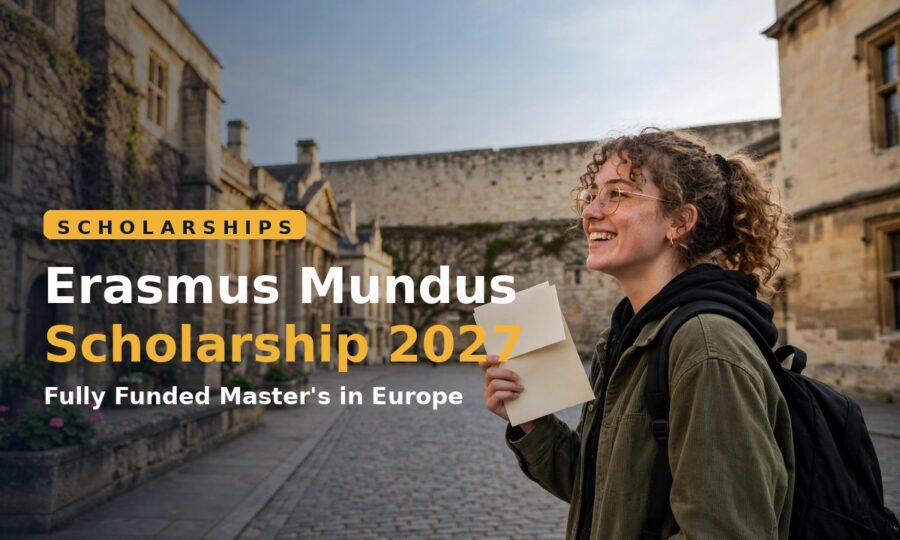
The Erasmus Mundus scholarship funds Erasmus Mundus Joint Masters — master’s degree programmes designed and delivered together by a group (a “consortium”) of universities in different countries, with funding from the European Union’s Erasmus+ programme.
Three things make the Erasmus Mundus scholarship different from an ordinary scholarship:
- You study in at least two European countries. A typical programme moves you between partner universities — for example, semester one in Germany, semester two in Spain, and your thesis semester in a third country.
- You earn a real master’s degree. Graduates receive either one joint degree issued by the partner universities together, or multiple degrees from the universities where they studied.
- The scholarship is fully funded. It is not a small discount — it is designed to cover your participation costs plus your living expenses for the whole programme.
There are more than 200 Joint Masters programmes in the official Erasmus Mundus scholarship catalogue, covering almost every field: engineering, data science, public health, law, environmental studies, media, business, social sciences, and many more. Programmes last one to two years (60 to 120 ECTS credits) and are taught in English in most cases, though each programme sets its own language rules.
There is no central Erasmus Mundus application. You apply directly to the consortium that runs the programme you choose — and that detail shapes the whole process explained below.

What the Scholarship Pays For
According to the official Erasmus+ programme information, an Erasmus Mundus scholarship holder receives:
- €1,400 per month for the full length of the programme, up to a maximum of 24 months (a maximum total of €33,600). The European Commission defines this monthly amount as covering your travel, visa, installation (settling-in), and living costs.
- Full participation costs covered — the EU pays the consortium an institutional amount per student, which is what removes tuition and participation fees from your side. In plain words: scholarship holders do not pay tuition for the programme.
That is the complete official picture. Notice what it does not include: there is no separate “flight ticket line” or “insurance line” in the student scholarship — your travel and other costs come out of the same €1,400 monthly amount, so budgeting still matters.
A second honest note: not every admitted student gets the scholarship. Each programme also admits some self-funded students. When you apply to a programme, you are normally considered for the scholarship automatically or asked to tick a scholarship box — check your programme’s page for its exact method. If you are admitted without a scholarship, you would pay the programme’s participation costs yourself, so read the costs section of the programme website carefully before accepting.
Who Can Apply? Eligibility Explained
The Erasmus Mundus scholarship eligibility rules are refreshingly simple compared to most big scholarships:
- Any nationality. Students from all over the world can apply. There are no country restrictions on the scholarship itself.
- A bachelor’s degree is required. You must hold a first degree (bachelor’s or equivalent) — or be in your final year of undergraduate study, as long as you graduate before the master’s programme starts.
- No age limit. The official rules set no upper or lower age condition.
- No work experience requirement at the EU level. Some individual programmes may prefer or require specific academic backgrounds, and a few ask for experience — the programme’s own page decides.
- Academic background must fit the programme. A data-science consortium expects a related first degree; a law programme expects a law or social-science background. Each consortium lists its own entry requirements.
- Language requirements are set by each programme. Most require proof of English (for example IELTS or TOEFL at the level the programme states); some accept a certificate that your bachelor’s was taught in English. Check your programme’s exact rule — never assume.
There is also one strategic rule to know: you may apply to a maximum of three Erasmus Mundus Joint Masters programmes in one cycle. Choose them carefully instead of applying everywhere.
Documents You Will Need
Every consortium runs its own application portal, so the exact list varies — but the standard package is:
- Passport (or national ID) — a scanned copy
- Bachelor’s degree certificate and full transcripts (with English translations where the programme requires them)
- CV / résumé — many programmes ask for the Europass format
- Motivation letter / statement of purpose — why this programme, why you, and what you plan to do with the degree
- Recommendation letters — usually two, from professors or employers, as the programme instructs
- Proof of English proficiency — test certificate or other proof the programme accepts
- Proof of residence — some programmes ask for a document showing where you currently live (used to calculate elements of the grant)
- Programme-specific items: a research proposal, portfolio, or additional essays for some fields
Prepare these before application portals open in autumn: certified copies and translations can take weeks, and recommendation writers need notice. Every document must be genuine — consortia verify credentials, and a single fake paper ends the application permanently.

How to Apply for the Erasmus Mundus Scholarship: Step by Step
Step 1: Open the official catalogue and shortlist programmes
Start at the official Erasmus Mundus Catalogue on the European Commission’s education website (eacea.ec.europa.eu). Browse by field and read each programme’s own website: curriculum, partner universities, entry requirements, and — most importantly — its own application deadline. Shortlist up to three programmes that genuinely fit your degree and your goals.
Step 2: Note each programme’s deadline
There is no single Erasmus Mundus deadline. Most consortia accept scholarship applications between October and January for programmes starting the following autumn — but some open later or close earlier. Write down the exact deadline, time zone, and document list for each of your chosen programmes. Missing a deadline by one day is the most common and most avoidable failure.
Step 3: Prepare your documents and motivation letter
Gather the documents listed above, tailored to each programme. Write a specific motivation letter for each one: name the actual courses, universities, and research strengths of that consortium, and connect them to your background and career plan. Generic letters copied between programmes are easy to spot.
Step 4: Apply on the consortium’s own portal
Create your account on each programme’s application portal (linked from the catalogue and the programme’s website), complete the form, upload your documents, and indicate that you want to be considered for the Erasmus Mundus scholarship. Applying is free — there is no application fee for the scholarship.
Step 5: Submit before the deadline — then wait for the selection round
Submit early; portals get busy near deadlines. Consortia then assess applications academically. Some shortlist candidates for an online interview; others decide on documents alone. Selection results are usually announced in spring (the exact month is each programme’s own). If you are not selected for the scholarship, many programmes keep a reserve list — places do open up when selected candidates decline.
Step 6: Accept, then arrange visas and travel
If you receive a scholarship offer, accept it within the stated time, follow the consortium’s enrolment instructions, and apply for the student visa or residence permit of your first study country. Your €1,400 monthly scholarship is designed to cover these visa and travel costs.
Official website to start from: the Erasmus Mundus Catalogue on the European Commission’s site — www.eacea.ec.europa.eu/scholarships/erasmus-mundus-catalogue_en — which links you to every genuine programme and its own official application portal.
Related Posts

Erasmus Mundus 2027 at a Glance
| Detail | Official information |
|---|---|
| Funded by | European Union (Erasmus+ programme) |
| What it is | Joint master’s degrees by university consortia in 2+ European countries |
| Number of programmes | 200+ in the official catalogue |
| Scholarship amount | €1,400 per month, up to 24 months (max €33,600) |
| Tuition for scholarship holders | Covered — no participation fees |
| Who can apply | Any nationality; bachelor’s degree required (final-year students may apply) |
| Programmes you may apply to | Maximum 3 per cycle |
| Application fee | None |
| Application windows | Set by each programme — mostly October to January for the following autumn start |
| Where to apply | Directly to each programme, starting from the official Erasmus Mundus Catalogue (EACEA / European Commission) |
After You Apply: Selection, Results and Visas
Selection is done by each consortium’s academic committee. Strong applications usually share three qualities: a degree and grades that fit the programme, a motivation letter that proves real research into that programme, and references who know your work well. There is no published “winning score” and no interview for many programmes — your documents must speak for you.
If you are selected, the consortium guides you through enrolment and tells you exactly which visa or residence permit to apply for. Two practical points:
- Each study country has its own student visa/permit process, and you will repeat a version of it when you move countries for a later semester. Start each application as early as the consulate allows, with your scholarship award letter as your financial proof.
- Keep your documents consistent. The names, dates, and degree details on your visa applications must match your scholarship application exactly — small mismatches cause real delays.
And if this cycle does not work out: an unsuccessful application costs you nothing but time, and many successful scholars applied more than once. Improve the weakest part — usually the motivation letter or the programme fit — and apply again next cycle. Our Visa guides section breaks down official visa processes step by step when you need them.
Common Scams and Red Flags
A scholarship this generous attracts fraud. Protect yourself:
- Anyone charging you to “apply for Erasmus Mundus.” The application is free and is made only on each programme’s own portal, reached from the official catalogue. A fee to “submit your application” is a scam.
- “Guaranteed selection” agents. No agent can influence a consortium’s academic committee. Guarantees are lies, full stop.
- Fake programme websites. Scammers copy real programme names onto look-alike sites to harvest documents and money. Always start from the official catalogue (eacea.ec.europa.eu) and follow its links — never from a random social-media page or a forwarded message.
- Requests to pay “processing,” “insurance,” or “visa deposits” to an individual. Real scholarship money flows only through the consortium and the university — never through a person’s bank account, gift cards, or crypto.
- Fake award letters asking for a “release fee.” If you did not apply to that programme through its official portal, the “award” does not exist. Verify any offer on the programme’s real website (reached via the catalogue) before acting on it.
- Document fixers. Sellers of fake degrees, transcripts, or language certificates are committing fraud — and universities verify. Getting caught means rejection and being reported, not a shortcut.
- Scholarship “groups” selling insider lists. Everything official — programmes, deadlines, requirements — is published free in the catalogue. There is no insider list to buy.
The rule from our other guides applies here too: if it is not on the official EU catalogue or the programme site it links to, do not pay for it and do not send your documents to it.
Frequently Asked Questions
1. How much is the Erasmus Mundus scholarship per month?
€1,400 per month for the duration of the programme, up to 24 months — a maximum of €33,600. The European Commission defines this amount as covering travel, visa, installation, and living costs. Tuition/participation costs for scholarship holders are covered separately, so you do not pay them.
2. Is the Erasmus Mundus scholarship really fully funded?
Yes — for scholarship holders it is one of the world’s most complete funding packages: participation costs covered plus €1,400 monthly. Remember, though, that programmes also admit self-funded students; being admitted and being awarded the scholarship are two different results. Your offer letter will state clearly which one you received.
3. When is the Erasmus Mundus deadline for 2027?
There is no single deadline. Each consortium sets its own; most scholarship application windows run between October 2026 and January 2027 for programmes starting in autumn 2027. Your programme’s own website — reached from the official catalogue — is the only deadline source you should trust.
4. Can I apply if I am in the final year of my bachelor’s?
Yes. Final-year students may apply, provided the bachelor’s degree is completed before the master’s programme begins. The consortium will tell you what proof to submit at the application stage (usually your latest transcripts).
5. How many Erasmus Mundus programmes can I apply to?
A maximum of three programmes in one application cycle. Choose programmes that fit your degree and goals — three well-matched, carefully prepared applications beat three rushed ones.
6. Do I need IELTS for Erasmus Mundus?
Each programme sets its own language requirements. Many require IELTS, TOEFL, or an equivalent certificate at a stated level; some accept proof that your previous degree was taught in English. There is no single EU-wide rule — check your programme’s requirements page.
7. Can I work while studying on Erasmus Mundus?
Student work rules belong to each country, not to the scholarship: many European countries allow students a limited number of part-time hours on a student residence permit, but the limits and conditions differ and change. Treat the €1,400 as your budget, check your host country’s current official rules after selection, and never let a job endanger the studies the scholarship is paying for. (If you want flexible online income that fits around study, our guide to virtual assistant jobs from home explains how beginners start legally from anywhere.)
8. Is there an age limit or a work-experience requirement?
No age limit exists in the official rules, and the EU sets no general work-experience requirement. Individual programmes may prefer certain backgrounds or experience — their own pages decide.
9. What are my chances of being selected?
Honestly: it is competitive — each programme has a limited number of scholarships for applicants from the whole world, and no honest source can give you a personal probability. What you control is fit and preparation: the right programmes, complete documents, and a specific, well-evidenced motivation letter submitted before the deadline.
10. I already have a master’s degree. Can I still apply?
Yes — holding a previous master’s does not by itself disqualify you from applying to an Erasmus Mundus Joint Masters, as long as you meet the programme’s entry requirements. Read your chosen programme’s eligibility page to confirm how it treats second-master’s applicants.
Final Thoughts
The Erasmus Mundus scholarship is rare in the scholarship world: genuinely fully funded, open to every nationality, free to apply for, and running on a calendar you can plan around — applications open each autumn for the following year’s start. The 2027 cycle is open now, and the students who win it are rarely the ones who heard about it last. They are the ones who shortlisted their three programmes early, prepared real documents, and wrote motivation letters that showed they had done their homework.
Start today on the official catalogue, note your three deadlines, and build your applications one careful step at a time. No agent, no fees, no shortcuts — just a fair process that rewards preparation.
Read the Next Guide: “Chevening Scholarship, Explained: How to Prepare a Winning Application for the Next Round” — our guide to the UK government’s fully funded master’s scholarship.