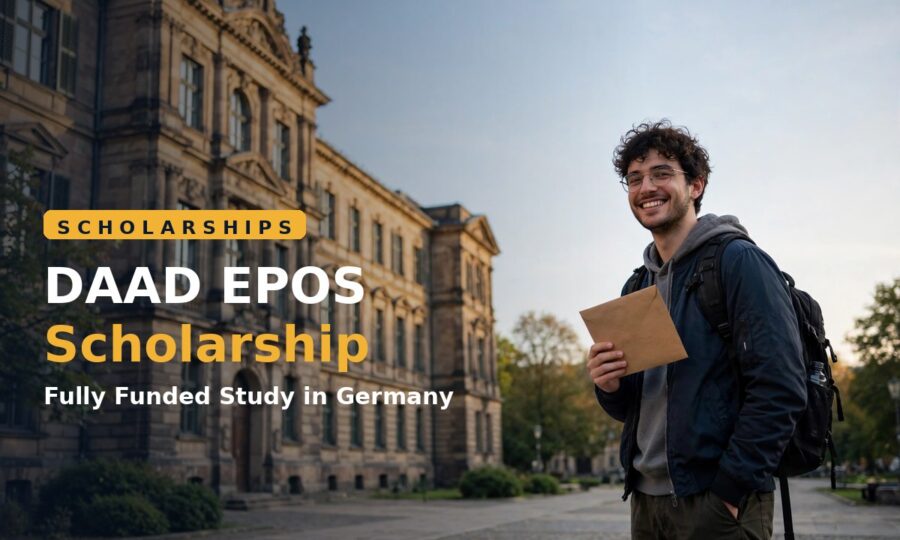
The DAAD EPOS scholarship is one of the few fully funded scholarships in the world built for working professionals, not fresh graduates. Through the DAAD EPOS scholarship, the German Academic Exchange Service (DAAD) funds master’s and doctoral studies in Germany for specialists from developing and newly industrialised countries. If you hold a bachelor’s degree, have at least two years of relevant work experience, and want a German degree with your living costs, insurance and travel covered, this guide is for you. Every fact below comes from DAAD’s official information — including the honest warnings about deadlines and agents.
What Is the DAAD EPOS Scholarship?
DAAD is the German Academic Exchange Service — Germany’s national organisation for funding international academic exchange. EPOS stands for Development-Related Postgraduate Courses (Entwicklungsbezogene Postgraduierten-Studiengänge), a DAAD programme funded by Germany’s Federal Ministry for Economic Cooperation and Development (BMZ).
The idea behind the programme is simple: well-trained local experts are the best guarantee for development in their home countries. So EPOS pays for experienced professionals from eligible countries to earn a postgraduate or master’s degree at a state or state-recognised German university — and, in exceptional cases, a doctoral degree.
Two points make EPOS different from most scholarships:
- It funds specific listed courses only. You cannot take this scholarship to any German university you like. Your course must appear on the official EPOS course list.
- It is designed for professionals. The typical scholarship holder works for a public authority, or a state or private company, on projects connected to development policy — in fields from technology and health to agriculture.
You can read the official announcement, including the course list, on the DAAD EPOS programme page in DAAD’s scholarship database.

What the Scholarship Covers
According to DAAD’s official programme information, scholarship holders receive:
- A monthly payment of €992 for master’s (graduate) students
- A monthly payment of €1,300 for doctoral candidates — rising to €1,400 from February 2026
- Funding for 12 to 42 months, depending on the study programme
- Payments towards health, accident and personal liability insurance
- A travel allowance, unless your travel costs are covered by your home country or another source
- Under certain circumstances, a monthly rent subsidy
- Under certain circumstances, a monthly allowance for accompanying family members
- For courses taught in German, a preparatory six-month German language course in Germany before the degree begins
One honest note about tuition: the official EPOS value list does not promise a separate tuition payment. Most German public universities charge little or no tuition, but a small number of listed courses do charge fees. Check your course’s own page to see exactly what applies to you.
DAAD EPOS Scholarship at a Glance
| Detail | Official information |
|---|---|
| Funded by | German Federal Ministry for Economic Cooperation and Development (BMZ), through DAAD |
| What it is | Scholarships for listed development-related postgraduate courses in Germany |
| Degrees | Master’s / postgraduate; doctoral in exceptional cases |
| Monthly payment | €992 (master’s); €1,300 for doctoral candidates, €1,400 from February 2026 |
| Duration | 12 to 42 months, depending on the programme |
| Insurance | Payments towards health, accident and personal liability cover |
| Travel | Travel allowance, unless covered by another source |
| Extra benefits (in certain cases) | Monthly rent subsidy; allowance for accompanying family members |
| Who can apply | Graduates from DAAD’s list of eligible countries |
| Experience required | At least 2 years of relevant professional experience after the bachelor’s degree |
| Where to apply | Directly to the course — never to DAAD |
| Maximum applications | Up to 3 courses |
| Deadline | Set by each course — there is no single DAAD deadline |
Who Can Apply? Eligibility Explained
The eligibility rules are stricter than for most scholarships, because EPOS is built for mid-career professionals. Based on DAAD’s official requirements, you must have:
- Citizenship of an eligible country. Your country must appear on DAAD’s official list of eligible countries (developing and newly industrialised countries).
- A bachelor’s degree — usually a four-year degree — in a subject related to your chosen course.
- Above-average results. DAAD describes the expected standard as far above average — normally the upper third of your class.
- At least two years of relevant professional experience, gained after your bachelor’s degree and counted up to the time of application. This is the rule that stops most fresh graduates. Internships and voluntary work generally do not count, and work in academic teaching or research is generally not accepted as relevant experience for this programme.
- A recent degree. Your academic degrees should normally not be more than six years old at the time of application.
- Development-related motivation. You should be able to show that your work and your study plans connect to development in your home country, and that you plan to take on responsibility there after your studies.
- Not long-term resident in Germany. Applicants who have been resident in Germany for longer than 15 months at the application deadline cannot be considered.
Unlike the Erasmus Mundus scholarship, which welcomes recent graduates and moves you between at least two European countries, EPOS asks for real work experience and keeps you in Germany. It is closer in spirit to the Chevening Scholarship in the UK, which also targets professionals — but EPOS adds a development-related course list and, in exceptional cases, doctoral funding.
How to Choose a Course from the EPOS Course List
Only courses on the official EPOS list qualify for the DAAD EPOS scholarship. DAAD publishes a document called the “List of all Postgraduate Courses with application deadlines” for each intake. The courses cover fields such as economic sciences, engineering, mathematics, urban and regional planning, agriculture and forestry, natural and environmental sciences, medicine and public health, social sciences, education, law and media studies.
Choose carefully, because your application must show a clear line between three things: your degree, your work experience, and the course. A health officer applying for a public-health master’s makes sense. The same person applying for an unrelated media course does not.
For every course you shortlist, read its own website for four things: the exact entry requirements, the teaching language, the full document list, and its own application deadline. You may apply to a maximum of three courses.
Documents You Will Need
DAAD publishes a standard document list for EPOS applications. The core package is:
- The signed DAAD checklist for EPOS applications
- The completed DAAD EPOS application form (typed, or clearly readable)
- A CV in reverse chronological order, with no unexplained gaps — DAAD asks you to use the Europass template, with exact details of your studies and practical experience
- One letter of motivation, covering your academic, professional and personal reasons for applying. If you apply to more than one course, this one uniform letter must also explain your course choices and your priority order
- A letter of recommendation from your current employer — on official letterhead, with signature and official stamp, and a current date
- Certificate(s) of employment proving at least two years of relevant experience after your bachelor’s degree — ideally including a guarantee of re-employment from your current employer when you return home
- Recent proof of language skills — IELTS or TOEFL for English-taught courses (note: the institutional TOEFL is not accepted), or German proof for German-taught courses
- Copies of your degree certificates — with a certified translation if they are not in German or English
- A full transcript of records — plus an explanation of your grading system if it is not shown on the transcript
- Applicants from the People’s Republic of China must also submit an APS certificate
Applications must be complete and submitted in English or German. DAAD states clearly: incomplete applications cannot be considered. Keep a copy of every document — if a course proposes you for the scholarship, you will need to upload the full set to the DAAD Portal later.

How to Apply: Step by Step
Step 1: Check your country and shortlist courses
Confirm your country is on DAAD’s eligible countries list, then open the official EPOS course list and shortlist up to three courses that match your degree and your work experience.
Step 2: Read each course’s own application page
Every course runs its own application process. Note each course’s deadline, its document list, and whether it applies online or by email. The course page is your source of truth.
Step 3: Prepare the full document package
Collect the documents listed above. Ask your employer early for the recommendation letter and employment certificate: these two papers take the longest in most workplaces. Write one motivation letter that also explains your course priorities if you apply to more than one course.
Step 4: Send your application directly to the course
This is the rule applicants get wrong most often: applications are sent to the course, not to DAAD. DAAD states plainly that applications sent to DAAD will not be forwarded to the course or university.
Step 5: The course proposes candidates to DAAD
A selection committee at the course reviews applications and suggests potential candidates to DAAD. You cannot contact DAAD to improve your chances at this stage.
Step 6: Shortlisted candidates upload to the DAAD Portal
If a course proposes you, DAAD contacts you directly and asks you to upload your complete application to the DAAD Portal.
Step 7: Final selection and result
DAAD completes the final selection, and proposed candidates are informed of the result. If you are selected, follow the course’s enrolment instructions and apply for your German student visa with your award documents.

Deadlines: No Single DAAD Deadline
There is no single DAAD EPOS deadline. DAAD’s official answer is that the deadline “depends on the chosen study programme” — every course sets its own date and publishes it in the official course list.
Related Posts


The honest pattern looks like this: many well-known EPOS courses close between August and October for courses starting the following year — several popular courses closed on 15 October 2026 for the 2027/28 intake. But other courses close earlier or later — there is no “October rule.”
So work backwards from your courses. Confirm each date on the DAAD EPOS programme page and the course’s own website, then give yourself at least six months of preparation before the earliest one. Employer letters, translations and language tests all take longer than people expect.
Do You Need to Speak German?
Good news first: many EPOS courses are taught entirely in English. For those, you prove your English according to the course’s rules — usually IELTS or TOEFL (remember, the institutional TOEFL is not accepted). You do not need German to apply for an English-taught course.
German-taught courses are different, and DAAD is strict about them:
- You need at least B1-level German at the time of application, proven with a current certificate.
- The scholarship then includes a preparatory six-month intensive German course in Germany.
- Before the degree starts, you must pass the DSH 2 or TestDaF 4 examination — passing is a formal requirement for enrolling at the university.
- DAAD warns that this level cannot be reached from zero in six months — the B1 base is a real requirement.
Whichever language your course uses, learning everyday German will make life in Germany — housing, offices, friendships — much easier.
Common Scams and Red Flags
The DAAD EPOS scholarship is generous — and that attracts fraud. Protect yourself:
- Agents charging you to “submit” your application. The DAAD EPOS application is free, and it goes from you directly to the course. No agent can submit it for you, and paying one adds nothing.
- “Guaranteed DAAD scholarship” offers. Selection is made by course committees and DAAD. Anyone who guarantees a result is lying.
- Anyone telling you to apply “through DAAD’s office” or a “DAAD agent” in your country. DAAD does not accept EPOS applications at all — courses do. Applications sent to DAAD are not forwarded, and anyone charging you to “send it to DAAD” is taking your money for nothing.
- Fake award or admission letters asking for a “processing fee,” “visa deposit” or “insurance payment” to a personal bank account, gift cards or crypto. Real results come through the course and DAAD’s official channels.
- Sellers of the “official EPOS form” or “secret course list.” The application form, the checklist and the course list are published free by DAAD.
- Document fixers offering fake employment certificates or degree papers. EPOS selection depends on verified employment proof — a fake certificate means rejection and can end your chances with German institutions permanently.
The rule is the same as in our other guides: if it is not on daad.de or on your course’s official university page, do not pay for it and do not send your documents to it.
Frequently Asked Questions
1. How much does the DAAD EPOS scholarship pay per month?
€992 per month for master’s students; €1,300 for doctoral candidates, rising to €1,400 from February 2026. DAAD also pays towards health, accident and personal liability insurance, plus a travel allowance (unless another source covers it) and — in certain cases — a rent subsidy and a family allowance.
2. Is the DAAD EPOS scholarship fully funded?
For your living costs, yes — the monthly payment, insurance support and travel allowance are designed to cover your stay for 12 to 42 months. The one point to check yourself is tuition: most German public universities charge little or none, but a few listed courses do charge fees, and the official EPOS value list does not promise a separate tuition payment.
3. How many EPOS courses can I apply to?
Up to three courses. If you apply to more than one, you must submit one uniform motivation letter that explains your choice of courses and your order of priority — and you must not change those priorities later.
4. Can I send my application directly to DAAD?
No. Applications are sent only to the course. DAAD states that applications sent to DAAD will not be forwarded to the course or university. If a course later proposes you, DAAD will contact you to upload your documents to the DAAD Portal — that step comes after course selection, not before.
5. My degree is more than six years old. Can I still apply?
DAAD’s rule is that academic degrees should normally not be more than six years old at the time of application. “Normally” means the standard expectation. If your degree is older, ask your chosen course directly how it applies the rule before spending months on an application — do not assume an exception.
6. Do internships count toward the two years of experience?
Generally, no. The two years must be relevant professional experience gained after your bachelor’s degree, proven with employment certificates. Internships and voluntary work generally do not count, and academic teaching or research is generally not accepted as relevant experience for EPOS.
7. Do I need IELTS for the DAAD EPOS scholarship?
For English-taught courses, you must prove adequate English according to that course’s regulations — usually IELTS or TOEFL. The institutional TOEFL is not accepted. For German-taught courses you need German instead: at least B1 when you apply, then DSH 2 or TestDaF 4 before the course starts, after the funded language course.
8. When is the DAAD EPOS deadline?
There is no single deadline. Each course sets its own, and DAAD publishes them in the official course list. Many popular courses close between August and October for the following year’s intake — several closed on 15 October 2026 for 2027/28 — but your course’s own date is the only one that counts for you.
9. Can my family come to Germany with me?
Possibly. Under certain circumstances, scholarship holders can receive a monthly allowance for accompanying family members, as well as a monthly rent subsidy. They are not automatic, so budget on the standard monthly payment and treat anything extra as a bonus.
10. I already have a master’s degree. Can I apply for another one?
Yes, EPOS funds postgraduate and master’s degrees, and a previous master’s does not automatically close the door. But expect to make a well-argued case in your motivation letter for why a second postgraduate degree is necessary for your development-related career.
Final Thoughts
The DAAD EPOS scholarship rewards a very specific person: a working professional from an eligible country, with a strong degree, at least two years of real experience, and a study plan that clearly serves development back home. If that is you, the DAAD EPOS scholarship is one of the most complete funding packages in the world — a real monthly income in Germany, insurance, travel, and a German degree.
Start where DAAD starts: the official course list. Shortlist your three courses, write down their real deadlines, and build your documents early — especially the employer letters. No agent, no fees, no shortcuts: with EPOS, the official route is the only route there is.
Read the Next Guide: “Stipendium Hungaricum Scholarship: Study in Hungary Fully Funded” — our complete guide to Hungary’s fully funded government scholarship for international students.