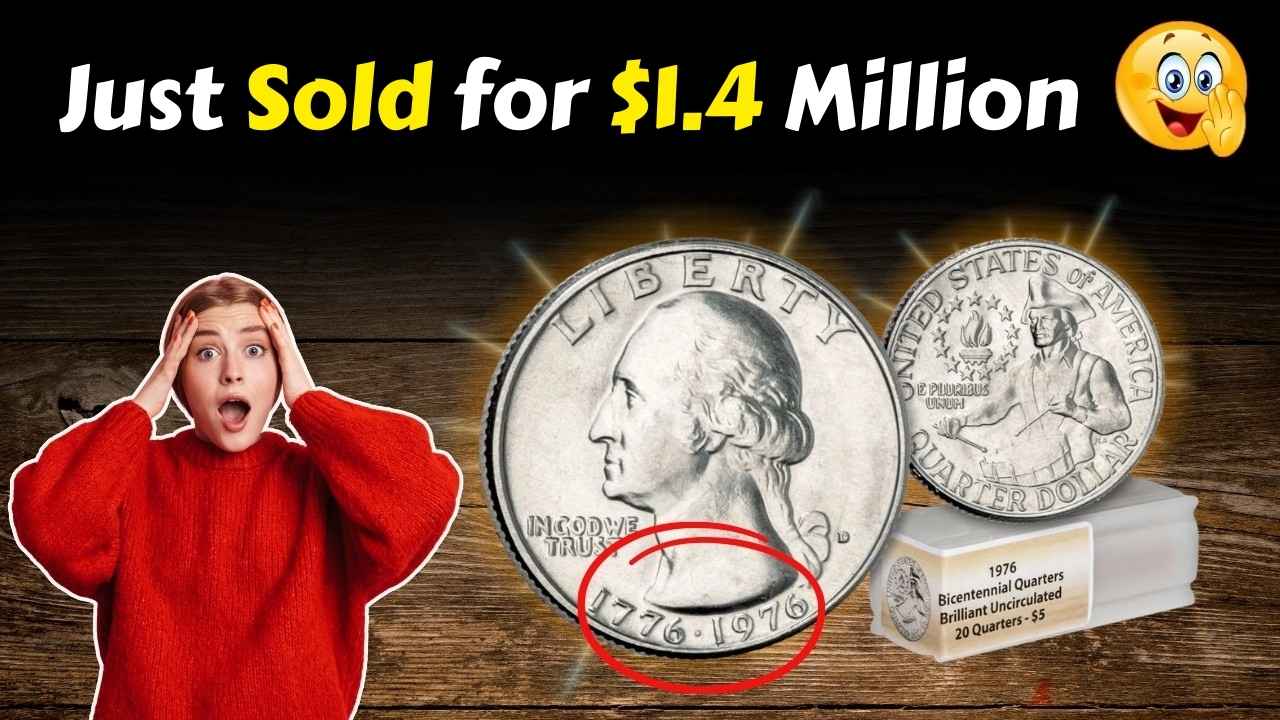
In a quiet town, a retiree stumbled upon what many collectors dream of a rare treasure hiding in plain sight. While sorting through an old jar of coins tucked away in the attic, they came across a 1976 Bicentennial Quarter. At first glance, it looked like any other quarter that has passed through countless hands over the decades. But once it was sent to a professional grading service, the truth was revealed: this was no ordinary coin. It was an extremely rare “Double Die Obverse” variety, and it recently sold at auction for a jaw-dropping $1.4 million.
Why This Coin Is So Special
The Bicentennial Quarter holds a unique place in American history. Struck in 1976 to honor the nation’s 200th birthday, it features a colonial drummer on the reverse a design familiar to millions. However, the coin found in the retiree’s collection carried something extraordinary. Because of a minting error, the obverse side shows a double image on the date and inscriptions like “LIBERTY” and “IN GOD WE TRUST.” This subtle doubling effect, known as a “Double Die Obverse,” makes the coin incredibly rare. Only a handful of such examples are known, and when preserved in high-grade condition, they can command life-changing sums at auction.
The Spark of a Treasure Hunt
News of the $1.4 million sale has reignited passion within the coin-collecting community and beyond. Social media platforms are buzzing with posts of people checking their jars, wallets, and even spare change at the gas station. For many, it’s not just about the money it’s about the thrill of finding history in the palm of your hand. After all, billions of Bicentennial Quarters were minted, making it feel like a treasure hunt with the possibility of striking gold.
How to Spot a Rare Bicentennial Quarter
If you’re wondering whether you might have a valuable quarter hiding in your collection, here are some quick tips:
- Look at the Obverse (front): Check for doubling in the date, “LIBERTY,” and “IN GOD WE TRUST.”
- Use a Magnifier: The error is subtle and usually needs close inspection.
- Check the Mint Mark: Philadelphia (no mint mark) and Denver (“D”) issues are the ones to watch.
- Condition Matters: Uncirculated or near-perfect coins bring the highest prices.
- Don’t Clean the Coin: Cleaning can ruin its value. Always let a grading service like PCGS or NGC handle verification.
| Feature | Details |
|---|---|
| Error Type | Double Die Obverse |
| Key Areas | Date, “LIBERTY,” “IN GOD WE TRUST” |
| Mint Marks | None (Philadelphia) or “D” (Denver) |
| Top Value | Up to $1.4 million |
More Valuable Quarters to Watch For
While the Bicentennial Double Die is making headlines, other quarters are also worth keeping an eye on.
| Coin Type | Potential Value |
|---|---|
| 1976 Double Die Obverse | Up to $1.4 million |
| 1969-S Double Die | Up to $90,000 |
| 1932-D Washington Quarter | Up to $143,000 |
The Bigger Picture
This discovery is a reminder that history doesn’t always live in museums it can turn up in our homes, purses, and piggy banks. A simple attic coin jar turned into a life-changing jackpot, sparking excitement nationwide. Whether you’re a seasoned collector or just someone curious about the change in your pocket, there’s always the chance of finding a hidden treasure.
So, the next time a 1976 quarter lands in your hands, take a closer look you might just be holding a piece of history worth a fortune.
I have a 1976 quorter but the drummers left eye is closed and droopy I haven’t found another like it is it worth anything and is anyone interested in buying